

The European biomethane market is entering a new phase. It is no longer just a topic of green energy, agriculture or biowaste processing. Biomethane is gradually becoming part of the broader European debate on energy security, industrial competitiveness and the stability of gas fuel supplies.
The reason is simple: Europe is looking for domestic, renewable and storable energy sources. Electricity from renewable sources is key, but it does not solve all the needs of industry, transport, heating or seasonal flexibility on its own. This is where biomethane has its place.
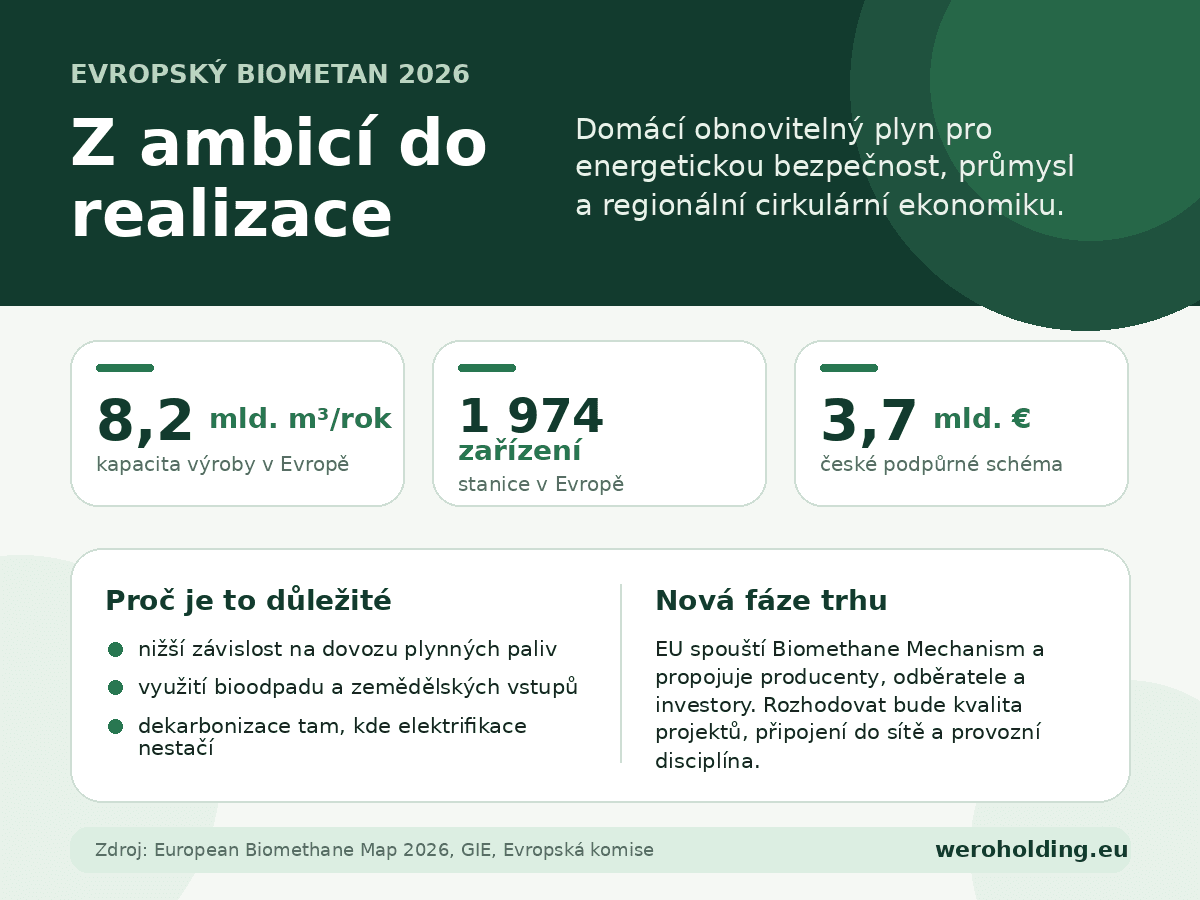
According to the latest European data, the installed capacity of biomethane production in Europe has already reached 8.2 billion m³ per year in 2026. The number of production facilities has approached the two thousand mark. This confirms that the market is growing not only politically, but also in terms of investment and technology.
At the same time, it is clear that the potential alone is not enough. The ability of individual countries to create a predictable environment will be decisive: clear support rules, rapid permitting, functional connection to the gas system and a transparent system of certification of origin and sustainability.
An important signal is the launch of the European Biomethane Mechanism by the European Commission. It is a platform that is intended to connect producers, consumers, investors and other market participants. In practice, this means an effort to remove one of the main obstacles to development: the lack of transparency between supply, demand, regulation and project financing.
Another important piece of news is the approval of the Czech support scheme for sustainable biomethane in the amount of 3.7 billion euros. This is a fundamental shift for the Czech Republic. We have an extensive base of existing biogas stations, experience with operation and agricultural and waste inputs, which, if properly set up, can be used more effectively than before.
Developments in Slovakia and other Central European countries are similarly important. The region has a very good starting position: existing infrastructure, agricultural background, local need for energy self-sufficiency and space for modernisation of older biogas plants. The speed with which the potential can be converted into specific projects will be decisive.
Biomethane is not just a “green gas”. It is also a tool for the circular economy. It allows for the energy use of biodegradable waste, slurry, digestate, agricultural residues and other local inputs. In addition to energy, digestate is also produced as fertiliser, biogenic CO₂ and other by-products that can have industrial uses.
This is particularly important for investors. The attractiveness of biomethane does not lie solely in subsidies or regulatory support. In the long term, it will depend on a combination of several factors: high-quality input raw material, good location, access to the grid, certification, operational efficiency, customer contracts and the ability to manage technological and regulatory risks.
At the same time, Europe is beginning to realise that biomethane is not a universal answer to everything. In order to have a real climate and economic benefit, it must be produced responsibly. The key is to minimize methane leaks, work with sustainable inputs, close material flows and use the best available operating standards.
That is why it makes sense to look at biomethane not as a fashion trend, but as an infrastructure sector. A sector that connects energy, agriculture, waste, industry and the local economy.
For Europe, biomethane is a way to replace part of its gas consumption with a domestic renewable source. For industry, it is an option to reduce the carbon footprint where electrification is not easy. For regions, it is an opportunity to increase energy self-sufficiency. And for investors, it represents a real asset segment where expertise, project quality and long-term operational management will increasingly matter.
The year 2026 shows that European biomethane is moving from the ambition phase to the implementation phase. Now it is no longer a question of whether it will have a place in the energy mix. The question is who can use this space professionally, responsibly and with a long-term vision.