

The European biomethane market entered a new stage of development in 2026. It is no longer driven only by technological potential or long-term climate targets. Production capacity is expanding, investment pipelines are growing, and concrete mechanisms are emerging to connect producers, buyers and financial institutions.
At the same time, it is becoming clear that building new production facilities alone will not be enough. The success of individual projects will increasingly depend on access to feedstock, connection to the gas grid, certification of origin, long-term offtake agreements and the ability to minimise methane leakage throughout the production process.
Europe Exceeds 8 Billion m³ of Annual Capacity for the First Time
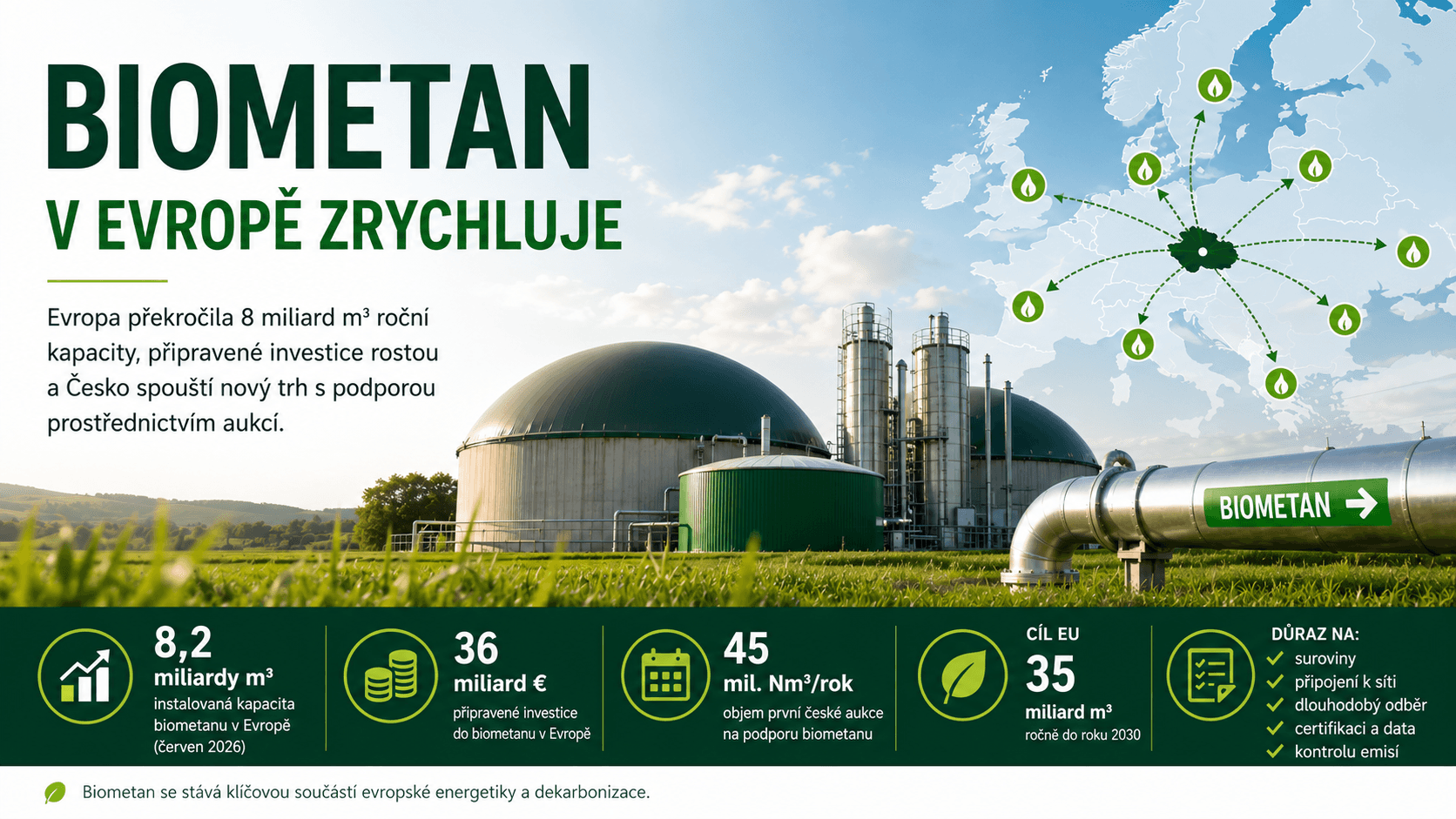
According to the new European Biomethane Map published by the European Biogas Association and Gas Infrastructure Europe, installed European production capacity reached approximately 8.2 billion m³ of biomethane per year by the end of the second quarter of 2026.
This represents a year-on-year increase of more than one billion cubic metres, or approximately 17%. The number of registered European production facilities increased from 1,678 to 1,975, with 327 new plants commissioned during the monitored period. Some older facilities ceased operations at the same time, meaning the net increase was lower. (europeanbiogas.eu)
The volume of planned investment is also rising significantly. The European Biogas Association currently records investment commitments of approximately EUR 36 billion, compared with EUR 28 billion in the previous edition of its outlook. If the announced projects are implemented, they could add approximately 9 billion m³ of annual capacity by 2030. (europeanbiogas.eu)
This is an important signal for investors and operators of biogas plants. Capital is available, but it will primarily flow into projects that have resolved permitting, feedstock availability, grid connection and an economically viable route to market.
The European Commission Has Started Directly Connecting Producers and Buyers
Another significant development is the launch of the European Biomethane Mechanism. The European Commission officially opened the mechanism on 18 June 2026 as part of the EU Energy and Raw Materials Platform.
The mechanism is designed to facilitate the identification of commercial partners, increase the visibility of supply and demand, improve transparency regarding national regulatory conditions and connect projects with financing opportunities. The first matching round for producers and buyers is scheduled for September 2026. (energy.ec.europa.eu)
The European Union continues to work towards the political objective of producing and consuming 35 billion m³ of biomethane annually by 2030. The European Commission estimates that achieving this target will require approximately EUR 37 billion in investment. (energy.ec.europa.eu)
The current figure of 8.2 billion m³ represents installed capacity across Europe, not actual production within EU Member States alone. The two values therefore cannot be compared directly. Nevertheless, it is evident that reaching the European target will require a substantial acceleration in construction and more efficient utilisation of existing facilities.
The Czech Republic Has Launched Its First-Ever Operating Support Auction
From a Czech perspective, the most important development is the European Commission’s approval of a new biomethane operating support scheme and the launch of the first auction round.
In April 2026, the European Commission approved a Czech support scheme worth approximately EUR 3.7 billion, equivalent to roughly CZK 90 billion. The programme is expected to remain in place until the end of 2030 and support both new biomethane plants and the conversion of existing biogas facilities. (ec.europa.eu)
The first Czech auction was announced on 12 May 2026. It covers support for an annual production volume of 45 million Nm³ of biomethane. Eligible projects include new production plants, conversions of existing electricity-generating facilities and standalone biogas upgrading units.
Projects must inject biomethane into the Czech gas grid and enter operation no later than 31 December 2029. The deadline for bids in the first round is 31 July 2026. (mpo.gov.cz)
However, the first auction has also shown that the design of the new market will require continued refinement. On 7 July, the Czech Ministry of Industry and Trade warned of possible attempts to submit identical projects in multiple auction rounds in order to secure more favourable support conditions.
The Ministry stated that such conduct could be regarded as an attempt to circumvent the principles of the auction mechanism and that the rules for future rounds would be evaluated further. (mpo.gov.cz)
For investors, this is an important warning: auction strategies must be based on genuine project readiness rather than speculation about future support levels.
Biomethane Trading Will Become Increasingly Data-Driven
In addition to production itself, the rules governing the traceability of renewable gases are also changing. The European Union Database covers transactions involving liquid and gaseous renewable fuels and monitors their journey from feedstock through production to final market placement.
For biomethane injected into interconnected gas infrastructure, certified producers are expected to record monthly volumes supplied to the grid. These figures are subsequently verified by transmission or distribution system operators.
The system also works with proofs of sustainability and is intended to reduce the risk of the same production being counted more than once. (energy.ec.europa.eu)
Certification, data reporting and the ability to demonstrate emissions performance are therefore becoming just as important to a project as the production technology itself.
Ukraine Is Becoming Integrated into the European Market
Ukraine is also emerging as a potential new source of biomethane for the European market. According to the International Energy Agency, seven biomethane plants were in operation in the country in March 2026, with an installed capacity of approximately 111 million m³ per year.
Ukraine completed its first export of biomethane to the European Union in February 2025. Later that year, the first road shipment of liquefied biomethane to Germany also took place.
A further five facilities with a combined capacity of approximately 20 million m³ per year are expected to enter operation during 2026. (iea.org)
The development of biomethane in Ukraine has both export and energy security significance. Decentralised biomethane plants can help reduce dependence on centralised energy infrastructure while creating a new source of income for the agricultural sector.
Growth Must Be Accompanied by Strict Emissions Control
Rapid biomethane expansion also comes with a technical condition: methane leakage must be minimised. The International Energy Agency warns that emissions from existing biogas and biomethane facilities may amount to approximately 2% to 5.5% of total production.
The most important mitigation measures include covered digestate storage, combustion of off-gases during biogas upgrading and systematic leak detection and repair programmes.
Without these measures, the climate benefits of a project can be significantly reduced. (iea.org)
What Does the Current Development Mean?
Biomethane is evolving from a primarily subsidy-driven and technological topic into a standard segment of the energy industry. A European market is taking shape, long-term contracts are becoming more common, certification requirements are becoming stricter and state support is shifting towards competitive auctions.
The most valuable projects will therefore probably not be those with the highest nominal production capacity alone. The decisive factors will be a combination of long-term feedstock security, a realistic permitting timetable, available grid connection, a stable buyer and a transparently documented carbon footprint.
The year 2026 shows that the European biomethane sector has capital, technology and political support. It must now demonstrate that planned investment can be converted into operational, resilient and genuinely sustainable projects.
Sources
- European Biogas Association and Gas Infrastructure Europe, European Biomethane Map 2026 and Biomethane Investment Outlook 2026, 1 July 2026. (europeanbiogas.eu)
- European Commission, Biomethane Mechanism: Connecting Buyers and Sellers, 18 June 2026. (energy.ec.europa.eu)
- European Commission and Czech Ministry of Industry and Trade, Czech biomethane support scheme and first auction, April–July 2026. (ec.europa.eu)
- European Commission, Union Database for Liquid and Gaseous Renewable and Recycled Carbon Fuels. (energy.ec.europa.eu)
- International Energy Agency, From Farms to Fuel: Ukraine’s Biomethane Opportunity, 15 June 2026. (iea.org)
- International Energy Agency, Outlook for Biogas and Biomethane. (iea.org)
#biomethane #biogas #energy #renewableenergy #decarbonisation #energysecurity #investment