

The European energy sector is changing. In addition to photovoltaics, wind and battery storage, renewable gases are becoming increasingly important. Among them, biomethane has a special place – a gas that can be produced from biodegradable waste, agricultural residues or livestock by-products and then used in the existing gas infrastructure.
One of the most interesting European examples today is Italy.
The Italian model shows that the successful development of biomethane does not rely solely on subsidies. These are important, but they are not enough on their own. The key is the connection of several areas: agriculture, waste management, gas infrastructure, stable legislation and a clear long-term strategy.
It is this combination that allows Italy to quickly develop new projects and modernize existing biogas plants.
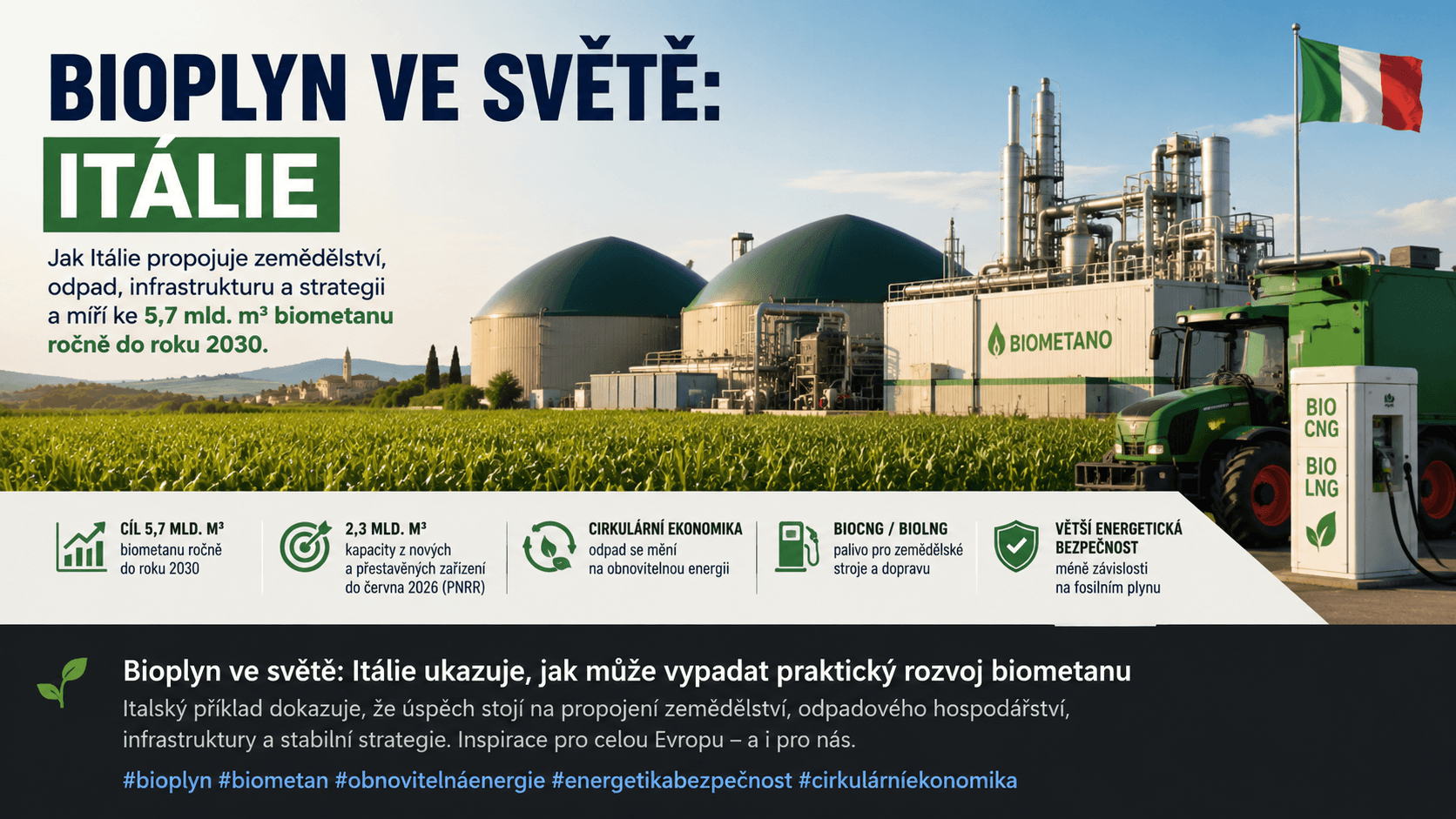
According to the Italian National Energy and Climate Plan, the country has the ambition to produce approximately 5 to 5.7 billion m³ of biomethane per year by 2030. For comparison: in 2024, production was around 0.4 billion m³. This means that Italy is not planning just gradual growth, but a real transformation of the entire sector.
The PNRR, the Italian equivalent of the Czech National Recovery Plan, plays a significant role in this. It plans to support new and rebuilt facilities and to develop biomethane capacity to at least 2.3 billion m³ by mid-2026. The practical aspect is also important: it is not only about building new sources, but also about using the infrastructure that already exists.
This is a fundamental lesson for other European countries.
Biogas plants do not have to be perceived only as sources of electricity and heat. With appropriate modernization, they can become part of a broader energy system: produce biomethane, supply it to the gas network, contribute to the processing of biological waste and support the local circular economy.
Another interesting direction is the use of biomethane as BioCNG or BioLNG in transport and agriculture. If an agricultural enterprise can produce renewable gas from its own inputs and then use it, for example, as fuel for technology, this closes a logical local cycle: waste becomes a source of energy.
Italy is also strengthening energy security. Every cubic meter of domestic renewable gas reduces the need for fossil natural gas imports and increases the resilience of the energy system.
The Italian example is relevant for the Czech Republic and Slovakia for several reasons. We have an agricultural base, existing biogas stations, gas infrastructure and growing pressure for more efficient management of biological waste. The decisive factor will be whether we can link these elements into a functional investment and legislative framework.
Biomethane is not a marginal topic in energy. It is one of the tools that can help with decarbonization, energy self-sufficiency and system stability.
Italy shows that where a clear strategy, infrastructure and practical use in agriculture and industry come together, biomethane can have a very concrete and measurable role in the energy mix.
And this is a direction that will become increasingly important in Europe.